Rysha Schuler
⭐︎ Designer and creator of social enterprise, APoet InPlainClothes ⭐︎
I first met Rysha in the summer of 2022 where we both served at the same restaurant in downtown Toronto — she was magnetic and charming, and at the time was asking people not to throw away the corks from the bottles of wine they’d open for their tables, as she was working on a project that required a lot of them. One of the first interactions we had, she had a large scarf wrapped around her in the staff room, and she lit up with a “thanks babe!” when I complimented her on it. Since knowing her I’ve kept up with her work, seeing the customs she’d make, the shoots she’d be apart of, and her life as a designer (amongst many other titles) continue to unfold. Fast forward 4 years later — when I started flirting with the idea of interviewing creatives in my community, sitting down with Rysha was a no brainer. I had her over to my house on a very snowy Thursday night in February to talk about her and her brand, APoet InPlainClothes, following her debut runway show for Toronto Fashion Week at the Toronto Reference Library. We sat criss cross across from each other on my couch, passed a joint back and forth, and let time slip away. We talked about the show, fashion school, why she doesn’t make clothes for boys, the heart and soul of APoet, and her plan for the social enterprise entirely. Her passion for what she does and where she is going was ever so inspiring. Incredibly thoughtful, sharp minded, quick witted, and with a desire to look at the big picture of it all, it is obvious Rysha is going to get exactly what she’s after.
Mya: Okay. Let’s start, shall we?
Rysha: Yeah, let’s start.
M: Okay, first, congratulations again on completing your first runway show. I felt honoured to come. I’m super proud of you. I hope you’re proud of yourself, I can’t imagine how that felt.
R: Thank you babe, yeah, it was a good feeling. I’m surprised it actually happened. I’m known to quit things right before the very climactic point.
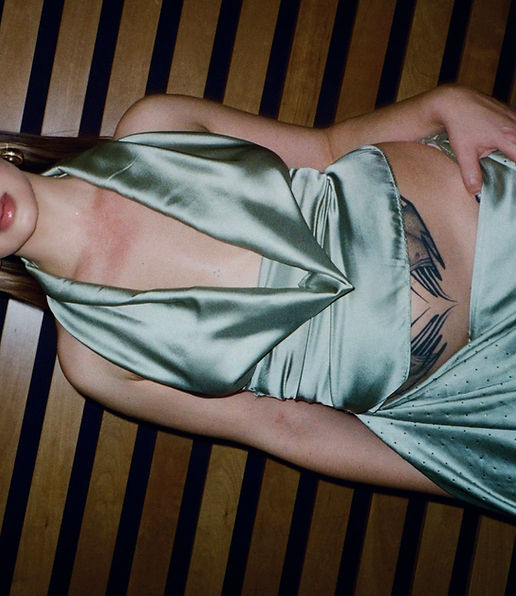
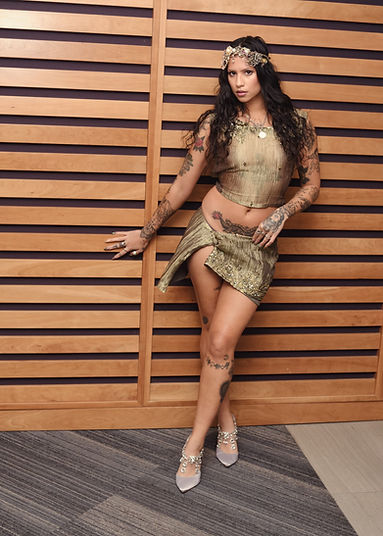
M: Something I love about APoet InPlainClothes is the materials you pull. Some of your pieces tend to come from more traditional clothing, from cultures that are known for being more conservative. Your designs are rather risqué — which I love. I’d love to unpack that a bit. What was your relationship with tradition, culture, and clothing growing up?
R: I think I always had a close connection to the clothing. Like sari’s and dupatta’s, traditional Indian clothing was something that I always, like, had an eye for and really, really loved. But I think being mixed made it a little different for me. In my head, I was still dressing up. It wasn’t, you know, me just wearing clothes. I don’t know if that makes sense, but I used to really look forward to certain religious ceremonies, weddings, stuff like that because I would be able to get dressed up in those types of things. I’m really close with my mom’s side of my family, but she didn’t have the greatest childhood and upbringing. So there’s a lot about her culture that she tries to protect me from because she kind of sees it from maybe a more misogynistic lens or something that made her feel trapped. So I’ve always had exposure to it, but like not a deep exposure. I experienced the food, I experienced the music, I guess kind of the art and culture, but like I don't know the really deep parts of it. I don’t know the language. My family is atheist, so I didn’t grow up with religion. So it can be disjointed at times, but I think super, super traditional, if you go back to the 1600’s and 1700’s, like, Sari’s are not the most modest outfits, you know, they’re risqué.
M: Are they?
R: Yeah, you’re not supposed to wear a blouse underneath; it’s supposed to be this kind of like sheer, really draping thing, you can lift your arms and you can see your boobs a little bit. Lots of fabric, but you’ll show one leg, that’s really traditional. After colonialism, with the British coming in after the 1600’s, it became more modest because it was “proper”, I guess. The modesty is kind of a Western influence.
M: I get what you mean about feeling like you’re not fully immersed in it [the culture], feeling like you don’t full belong in the clothing, but you want to. Feeling shy and reluctant to emit those parts because of feeling too white to be there.
R: Right, because at the same time you understand what you get with the whiteness, like what comes along with it. There’s a guilt in exploring the other side of your culture because it’s like, ‘this is for them.’
M: Do you feel like, in terms of the pieces, when you use these Sari’s and you use these materials, that you feel like you’re trying to gain the depth of the culture, it’s this romantic thing in your mind and you’re like, ‘let me play with this and be able to connect to it more and understand it in a way thats mine’?
R: Totally. Exactly. It gives you agency and the ability to connect to something that I felt a little bit more distance from, growing up.
M: I love that.
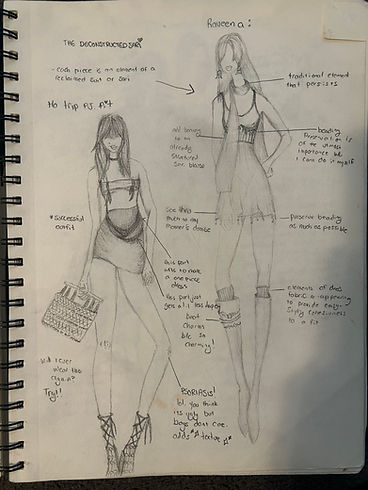
R: It’s also just really beautiful. I just love the fabric and I love how it is beaded already, I really believe in preserving. When you’re reworking, you should rework the actual fabric, but also repurpose the labour as well. The labour is super, super valuable — all those hours spent embroidering sari’s or beading them or whatever the technique is that’s being done, that’s hundreds of hours. So to be able to preserve that is special and beautiful too, I think. To be so real, there’s not much going through my mind when I’m creating each piece. I kind of just do it based on what looks nice, but I think that I guess I try to do it as authentically as possible. A long time ago I realized that both sides of my culture is what makes me, me. So I just keep that in mind when I source my clothes and my textiles.
M: Is fashion, and designing specifically, always been something you’ve been drawn to, or was it introduced to you at some point that you sort of fell in love with?
R: Yeah, it was something that I was always in love with. This Christmas, my parents have a little time capsule of our arts and crafts we did as kids. And there were things that I wanted to accomplish, like when I was in grade three the number one things on my list was “have a good job”, and then in brackets, “preferably be a fashion designer.” So it was something that I always knew I wanted, but by the time I was in grade eight I became very practical. I wanted to be a lawyer. I went to university for human rights law. I never saw myself in the arts world. I saw that as… I don’t know, just not me.. and then during Covid, when we got laid off at the restaurant, I just needed money and started selling stuff, and then became a thrift store pretty organically. From there, I went to styling and mending stuff that I needed to style, and then from there, free working, and then cut and sew and designing. So it’s been a slow evolution, but in school, I think people would have referred to me as an athlete. I played so many sports and did not do arts and crafts, but one consistent thing about my personality is I always like to dress well. My parents, being socialists, didn’t like to spend a lot of money on clothes. So I discovered thrifting, like super, super early; maybe 11 or 12 years old. I started going to the Salvation Army across the street from my house, and that was kind of my way of being able to afford nicer things that I wouldn’t have been able to otherwise. And I think when you thrift you really learn how to have a personal style; you have to, because things aren’t on the mannequins laid out. It’s kind of like an exercise in styling. I feel like everyone I know who thrifts, can dress themselves well, you know?
M: Yeah, definitely, because you have to be able to visualize.
R: Exactly. But yeah, I’ve always had a passion for clothing, but it became apart of my lifestyle after Covid.
M: Do you feel like your personal style has changed in those different phases?
R: No.
M: No?
R: I’ve always reached for beautiful pieces; I think when I was younger I found it really, really hard to compete with trends. I grew in an immigrant community where moms worked two jobs and stuff like that. My community itself wasn’t affluent, but I played soccer in really rich areas, hockey in rich areas, where girls were 11 years old, and front row at the Jonas Brothers type shit. So I never tried to compete with trends because it was too inaccessible for me. I always just went for things that I felt to be beautiful. I feel like I could wear anything I’ve ever worn at any point since like 13 or 14, because it’s all just beautiful things, not trendy things.
M: Wow. I feel like not a lot of people can say that.
R: That’s my biggest flex. Like go back on my Facebook — I’d still wear that.
M: That’s also just such a good way to view life. If you’re looking at your clothes like that, I can imagine you’re also looking at other parts of your life like that. When you learn to live life by immediately seeing the beautiful parts of it, it’s so much more fun.
R: Totally. You’re right. I try, I think I try to do that.
M: I mean, obviously life is life, but if you can pick up the pretty parts, it makes it a little easier.
R: Especially when the world is on fire like this, that’s the only coping mechanism, to look at the beautiful sparkly things.
M: What community did you grow up in?
R: Victoria Park and St. Clair, like kind of Scarborough. And then I went to high school in Markham. Scarborough is really multicultural, and then Markham was like, a total ethnic enclave, a culture shock. Everyone called me a white girl because I was the whitest girl in the whole school. And it definitely helped me shape my identity for-sure, I think sadly we tend to, growing up, think one side of our culture is better than the other side, or superior in some sense because the world has led us to believe that. So I think growing up around people that were of the same culture as my mom really helped me become that. Whereas otherwise I think I would just be like, you know…basic.
M: Nightmare.
R: You know?
M: Where did you go to school for fashion?
R: George Brown, for technical fashion and design. It was a nightmare program.
M: Really? How long was it for?
R: I did three semesters and it was a four semester program, so I dropped out just before I graduated. I just couldn’t do it anymore. I have my university degree, so I wasn’t going there for any sort of degree or paper. I was going there to literally learn how to sew. That’s what I wanted to do. And they’re really good at teaching the technical aspects and I feel like I learned as much as I needed to learn in those three semesters, but I think there was a difference between college and university. University fashion school teaches you how to be a designer, whereas college fashion school teaches you how to be a good tailor or a good seamstress, which means working for someone, less artistic output, maybe lower pay, but probably more stable pay. I’m not saying one is necessarily better than the other. But I think George Brown super leaned into the technical side, with not a lot of room for the arts or beauty of it. Which is unfortunate, because there is a disparity about who goes to college and who goes to university. Some people have opportunities to go to college and some have opportunities to go to university, But then what ends up being produced is a lot of people from similar upbringings, becoming you know, the fashion designers of Toronto and people with all these kind of rich cultural stories being like the workers first then designers. So I didn’t like that. I didn’t like how there was no creativity and no expectation for creativity from the teachers. Because they need to recognize the disparity and give kids the opportunity to exercise that part of their brain as well.
M: Yeah, 100%. I also feel like sewing is inherently artistic, you know? I guess it can be scientific, but it’s an art for-sure.
R: Yeah. It has it’s scientific and mathematical moments that really stress my brain out, but yeah it’s definitely an art. Everyone should be able to make their own garment, you know, see it through start to finish, not just be the person just doing the drafting.
M: Do you regret going to school?
R: Not at all. I wouldn’t have been able to learn as many skills that I have, in such a short amount of time, if it wasn’t for the technical training. Before I did that, there’s something that never really sat right about selling clothes for me.
M: Really?
R: That were handmade? Yeah. In retrospect, I didn’t know, but looking back on it now, some of the things were not made well, and some of the things I just didn’t know what I was doing. There’s the ethics, I guess, attached to it. Like I don’t want to keep selling a shitty product. And then I think there was a big realization for me about why I was going to fashion school. When I went to India, I went with my intern at the time, but she was a graduate from a fashion design school in Paris, so she was really technically skilled. And on the trip, we were trying to design a silk shirt that was supposed to be a staple closet piece, just a plain white silk shirt. That was the idea. There were a lot of gaps of knowledge that I had in the development process of a shirt, there were some arguments that we had that now looking back on it knowing the technical things I do know now, I know what she was saying; like if something’s impossible, it’s impossible. So, you can’t lead people, have employees, if you yourself don‘t know what you’re doing, like really, really intimately. So if I wanted to scale this at a point and hire people, it would be in my best interest to know as much as I can know.
M: That makes a lot of sense, and is smart to think about it like that. If you’re going to employ people, you don’t want to be put in a position where someone you’re employing is correcting you on something, where you should be the teacher. We can all learn from each other, but I know what you mean.
R: Yeah. You also don’t want people to be taking advantage of you and stuff like that. Like now I know how long it takes to do certain things, what’s a reasonable ask of people design wise, what’s unreasonable. I’m definitely grateful for the technical side.
M: Were you selling much of what you were making at that time?
R: I wasn’t. I don’t really, still. I don’t like parting with my things. Commissions, sure. But no, I wasn’t really, but the idea was always to start selling. It’s so much easier doing commissions now that I have this knowledge. Like someone would ask me to do something before, and I’d be like ‘…okay…? I’ll try to figure it out’. I think also because I was in the fashion world, styling before, I had some really good connections and a good network, and because of that they were entrusting me to do design work for them, and it wasn’t imposture syndrome, I actually just wasn’t good enough to do it. I’d be getting good jobs, for celebrities, and I would not know how to deliver the product. And it was stressing me out, it was ruining my relationships in the fashion world that I did work so hard to build up. So the logical solution was fashion school.
M: Good for you though, for being able to recognize that and take the steps. Where it’s like, you want something and you have it it a sense, but actually want it. You’re like, let me go figure this out, because I want to do this correctly.
R: I actually can’t take credit for that thought. It’s from a Lauren Hill song. Do you like Lauren Hill?
M: I love Lauren Hill.
R: It’s from this song off MTV live unplugged album where they recorded one of her concerts. I’ll send it to you. But she’s just like, you can’t preach unless you’re living it. You can’t teach people things unless you actually know it or else it becomes commercialized, not authentic. It’s about doing things as basic and simply as possible, getting that down, and then building up from there.
M: In fashion school was there anything your professors said to you that has stuck with you to this day?
R: No. I did the homework and handed in the project. But in university, yes. I took an international development class. The whole point of the course was to kind of teach us about white saviourism and about aid in countries like Africa, from French, English, Dutch superpowers, which resulted in so much war and stuff because aid was not allocated to the right places, with so many levels of bureaucracy, money gets lost. And then in an effort to modernize something you don’t know about, you strip the culture of a lot of things.
M: Yeah.
R: The goal of the course was to try to teach us that, yes, doing good is good, but you’re the person you’re supposed to do good for, like the younger version of you, helping something that you know intimately and personally. Because if you try to dip your toes into helping someone or something that you know nothing about, thats when the idea of a white saviour can come in and it’s super dangerous, and can hurt more than it can help, you know? So I think that’s a big thing that stuck with me. I overall, want this to be more of a social enterprise than I want it to be a fashion brand. And I think that’s a lot of that is because how I can make my positive mark on the world is by solving a problem that I know really intimately about, or know about personally.
M: Wait, I’m going to write that down. Social Enterprise. I love that. You’re so well spoken.
R: Thanks babe, I feel like I’m not. I feel like I probably smoked too much weed before I came.
M: When you talked about doing it for your younger self, do you still think about that actively, like doing things for your older or younger self?
R: Totally. Never my older self, which is maybe toxic, I’m never thinking about the future. But definitely [for my younger self]. Growing up, I felt like I was constantly I guess like, competing with people for opportunities, for boys, stuff like that with people who had more money and more resources than me. I just always felt like I couldn’t afford what I wanted to buy. I want to alleviate that pressure from young girls because it shouldn’t be the wealthy who can only express themselves, you know?
M: 100%.
R: I would love if there was some sort of like, girl ecosystem that I had with a bunch of people with different skills, like exchanging stuff.
M: That’d be sick.
R: Have you seen? It’s kind of a trend on TikTok, the artist cards?
M: No!
R: Oh, I want to be a painter so badly now. So it’s artists painting small cards. Like beautiful, beautiful cards. And then they just trade them with other artists. But like the only people allowed in that is obviously people who can produce their own beautiful artworks.
M: Cute!
R: I can’t get original art in this city. It’s impossible. It’s a million dollars to try and get something original, which just makes no sense to me.
M: I want to talk about the name of APoetInPlainClothes. It’s beautiful and memorable. Was it a name that came easy to you?
R: Yes.
M: Is there a story behind it?
R: There’s no story behind it. It honestly just sounded nice, it just came to me as just an alliteration, and then I just started making sense of it after it was created. I wasn’t thinking hard about it. It was this phrase and then I made sense of the phrase. But at the start, when I was a thrift store, we wanted to sell affordable, thrifted capsule closet pieces. So we did a lot of leathers and furs.
M: Love that.
R: That was kind of our specialty. So it was I guess like, personal expression through simple things, which would be a lot to say. Now, however, the clothes aren’t so plain, and I definitely don’t like making plain shit. Thrifting was a big part of the name. When we were talking about me always being able to wear the clothes that I’ve always had, apart of that timelessness is the quality and durability, but also I guess a little sense of neutrality. Like it doesn’t have to be a neutral colour, but not so many crazy things going on with the capsule pieces, I guess you could say. Now I don’t make that at all. So it’s become kind of the opposite. I still like it for it, and I feel like now it’s become kind of ironic, that the clothes are not plain at all. Also my slogan is, ‘for those of us who wear our art on our sleeves.’ And it makes more sense now than it did before. But again it was something that I made up because I thought it sounded good, and then I made sense of it after. Because again, I like pretty things.
M: Yes!
R: Pretty as the base, and then, you know, things build up from there.
M: I totally feel you, and I see no issue living life like that.
R: it’s like a little dose of serotonin.
M: Your designs have so much personality. Did you ever stress about finding your own voice amongst your peers?
R: Yes and no. I think when I first started sewing, I had a moment of hyper-fixation on what people call a design feature. So like you look at a designer’s piece and you know its theirs because of this little signature thing they have. And thats honestly something really prevalent in the Toronto fashion community, like most of these small designers have that one thing, that one viral thing, then they make slight variations to that. So I have stressed about that. And especially because the way my mind works, I never want to make the same thing twice. I love exploring different things. It hurts my heart to make the same thing twice. I like to always be excited about what I’m doing. The way designers work, it probably was like they made a design signature and then made a bunch of things. They probably, like, the good ones — Rick Owen’s, Vivienne Westwood, they probably just designed authentically, and then because they’re doing it in an authentic way, there’s some sort of commonality that ties them all together, and then eventually that evolved into a design signature. So I was like, my design signature might not happen to me until I’m like, 65 years old. I’m no longer stressing about it. But I’m confident with my reworking abilities. I think that the culture of reworking is like finding something, picking it apart at all the seams, and putting it together in a new way. What I like to focus on is, again, preserving the labour, so keeping design elements like zippers, seams, hems, but reimagining them in a completely different way.
M: You’re crazy good at reworking.
R: Thanks babe.
M: Who are local designers that you admire?
R: Sagradesa. She’s my icon. Yeah. I met her when she was in fashion school at TMU and I was a stylist. I produced her first fashion editorial shoot. Seeing her grow and become a household name in the city is so iconic. She’s also a mixed girl, she’s half Colombian, half white. I just love her stuff aesthetically.
M: Are you someone who’s hard on themselves? Do you celebrate your wins or do you overlook them?
R: I don’t think I’ve ever felt the need to celebrate my own wins, because I have such a good group of people around me, they celebrate for me. Probably more than what’s healthy for my ego. I’m blessed. My parents, my brother, my close friends that I’ve been best friends with since I was little. They’ve always done that for me.
M: That’s awesome. You were showered in so much love after the show. It was so sweet to watch.
R: That was my favourite part of it.
M: Yeah?
R: Mhm, For sure. Just seeing everyone there, it warmed my heart. Because it’s like, I do it for you guys. This is the purpose of it. It’s not for, I think, my own self satisfaction.
M: What was your biggest challenge with this collection?
R: Everything. Like how do I pick. Different stages there were different challenges. At the start, being cohesive was a challenge. I was really overthinking it. I was like, I want this to have the white and the brown side of me, and this element will represent the white, and this element will represent the brown, and I had finished like six or seven things, and my stylist came over, and she was like ‘okay, how are we going to tie these together?’ and I’m like, ‘Yep, heard, you’re right, I have no fucking clue.’ They were all different. They were the same in meaning, they’re half of me and half of me and if you sat down and talked to me, you could know all about each individual outfit, how they are all connected with each other, but at first glance, they weren’t at all. So I went back to the drawing board, and then she [stylist] said there were two pieces she really loved, one was giving Versace resort circa 2002. So I looked up Versace 2001-2004, and used that as my anchor inspo for the aesthetic part of the collection.
M: That’s a vibe! I like that.
R: Thank you! But yeah, that was a challenge we overcame… model casting was a challenge as well, because I wanted it to be people I know and that I loved, like that was important for me, but I also wanted people with professional experience. My whole thing was like, all these girls who I was casting were multi talented in someway — this girl’s doing her masters, this girls an artist. It was just a cool thing that I was trying to work on, and also making sure I had professionally experienced people and representation. I wanted it to be diverse, but also like, a good amount of brown girls, because I’m borrowing obviously so much from brown culture.
M: Yeah I was going to ask, how was it working with a team of models? Like, have you ever worked with a group of models like that before, or overseeing them in some type of way?
R: Yeah, I’ve done some smaller scale stuff, I used to produce events and sometimes fashion shows for them, little pop up shops and stuff like that. So I do have some experience with that. This time though, I didn’t really have to do much because I had Meg, my amazing stylist, and she alleviated a lot of that stress in the sense that I just had to work on my clothes. She dealt with the accessories, what model was wearing what, who was coming out when.
M: Oh, that’s awesome.
R: Yeah I couldn’t have… I couldn’t have done that.
M: I have this written down for later on, but I was going to ask if there was someone who you leaned on the most during this, and was that her?
R: Yes, Meg. Totally Meg. She was with me the whole time. We’ve always just creatively clicked, and I think that’s super rare for me. I don’t like giving up creative control at all, unless I genuinely like the ideas. And I don’t know — Meg never misses.
M: That’s such a satisfying feeling. How did you guys meet?
R: When I had a thrift store, I wanted to do a garage sale. Me and Taylor, my old business partner, we set up a little vintage pop up shop on my front porch, which I ended up getting in so much trouble for, because apparently you can’t do that. Who knew!
R: But yeah, Meg just came to that. She was walking by. She and her friend call them hot girl walks, and they were on a hot girl walk by my house, saw the pop up shop, and came in. I started chatting and then Meg was the first person to ask me if she could pull stuff for me. She kind of started the whole styling thrifted stuff, which is not new now, but I think at the time was kind of a newer thing. At the beginning of Covid I feel like the norm was, if you’re selling thrifted clothing and it’s not designer thrift, it’s like a girl standing straight up with the top and the bottom and then the caption says how much it is. So I think it gave us a unique edge, doing the photo shoots with thrifted outfits. So yeah, and then she helped me build my community; she introduced me to so many people. She had been styling for three or four years before, so she had a lot more experience than I had, so it definitely taught me a lot of things.
M: That’s the sweetest meet cute ever. What a good friendship story. Shoutout Meg.
R: I know.
M: Did you have a eureka moment making this collection, or a moment of like, okay, yes, I can see this full vision now.
R: Yeah, I think it was when we were at Meg’s house, the morning before the show. We were looking at all the pieces and I was like, I’ve never been this prepared or organized for anything, largely because of her. I’m such a last minute person, I’m rushing to meet deadlines. So I sat there and was like, there’s nothing pressing right now. There’s nothing that I’m going to be scrambling around doing, so I actually feel okay about this.
M: Which piece took the longest to make?
R: The bangle dress.
M: I was also going to ask, cause I’m wondering if it’s going to be the same, what piece was the most challenging to make?
R: The bangle dress wasn’t challenging, it was really just adding loops together, it was just so time consuming. I re did it three times to figure out the structural integrity. The first time I did it, it involved so much fucking math. I was doing specific patterns, I did a beautiful ombré vibe, and then it fell apart when I tried it on. Did it again, but with a little bit less intention, worked worse. Then I got the model to come, did it again on her for her body but with way stronger metal loops and everything. Everything seemed good. Then we got backstage. I wanted her to be the centrepiece of my collection, and then it fell apart three minutes before the runway. I almost cried. But yeah, the bangle dress you saw on the runway, was not the original dress at all. That was just figuring it out.
M: Did that taint it for you a little bit, or are you able to move on from stuff like that?
R: Um, I’m able to move on really, really well from stuff when I have a joint. But I was trapped in there, so I was really nervous and hyper-fixating, but she was the last person [to walk]. So I was fixing her up until the very last second before she walked. And then two seconds later it was my turn to walk. And then once I walked out there and saw my friends and my family, I was like, man, nothing matters. Like who the fuck cares? I feel like people didn’t really notice. I obviously noticed, but she played it off well and it was fine and I got over it.
M: That dress was crazy, it was really cool. Honestly, every piece was sick. My favourite was towards the end, the pink little two piece set. SO good.
R: She [the model] has a great walk too.
M: How close up until the show were you working on the collection?
R: Probably like two days before. I did Sadiq’s [Rysha’s old roommate] pants the day before, that was my last thing.
M: That was so sweet to have him as the DJ. That was such a lovely little touch.
R: Yeah, and having Kristian and Trinity [Rysha’s close friends] walking in it was really special too. Kristian’s been along the whole time on that ride, and Trinity, I did her first photo shoot. I have a lot of history with that family, and I love them so much.
M: I have a question about Kristian in here, actually. It’s obvious by your designs that you love women. Your pieces are very feminine, colourful, and sexy. How would you describe your relationship with designing and women? I was shocked to see a man in your show. Did you want to include a man in this body of work, or was it more that you wanted to write him in because of your guys relationship?
R: Yeah. I wanted him to be apart of it because of our relationship. And like yes, I design for the girls, but like, the girls and the gays.
M: Totally.
R: I think having one guy was a good way to showcase: I don’t make men’s stuff. But I’ll make something for the gays. Like, hit me up for a custom, I’ll do that. A lot of the feedback I get is it [APoet] is exclusionary, you know, like not ever making stuff for boys.
M: Really?
R: Yeah. It’s so fucking annoying.
M: Like what, just boys complaining?
R: Yeah. They don’t get it. I’ll be telling them the problem so straight up and plainly. I’m like, ‘listen, there’s so many incels.’ They’re in the DM’s. If I start saying that I make clothes for boys, do you know how much time is going to be wasted, chitchatting with a boy who’s just talking to me? He doesn’t want my piece, he just wants to waste my time. I’ve also had bad experiences doing commissions for men, like one guy shorted me $500.






M: Were you nervous the day of the show? I think that’s a pretty easy question, but I was curious.
R: Yes, I was a little bit. But it was chaos pretty quick. Like, there was kind of a lull before, but then two hours before the show it became chaotic. It was nonstop. So I wasn’t in my head worrying, I was in my head getting shit done. There’s a checklist that needs to be followed. So yeah, nervous, but many smoke breaks that day. I was like, ‘Meg, hold it down, I gotta go outside the Toronto Reference Library for a quick spliffy.’
M: I love that the show was called ‘My First Poem’. Like, that detail is everything to me. I also loved, you posted the sweetest video that gave a behind the scenes of how the day of the show was. And there was a part where you and all the models were sitting and you gave a speech. It was so touching.
R: I couldn’t even get through it. Just the first sentence and I felt the tears.
M: But even that, it said everything it needed to. Like it was so emotional, I can’t imagine how magic the energy in that moment felt. How did it feel for you?
R: It was so good. It was. It was everything coming together, and the model team, even the people I cast from Rchive that I didn’t know, they ended up being such bubbly, magical, amazing personalities. So yeah, it was really, really special. I feel like now I should have just been more vulnerable and done the whole speech and cried and whatever, but just in the moment I was like ‘no, fuck that. We gotta get shit done. No crying! End speech.’
R: I think there’s kind of a vibe in the culture that is now changing, like just this year, but I think the past couple years apathy is cool and low effort, jeans and t-shirt to the club is cool, and any sort of expression is trying too hard. And every single person I casted, I think, has really strong personalities and is really intentional about everything they do. And I wanted to bring intentionality back to the show and in all facets, you know, like there was detail to everything.
M: Yes, very detail oriented.
R: Yeah, like whether it be something people see or whether its just for me in my head to make me feel a little bit warmer.
M: If there’s anything you could change about the show and how it went, would you? Besides the bangle dress?
R: So, let me tell you this tea, I’m walking around barefoot, right before I’m about to go out, because I had heels to walk it. My Ferragamo heels. And then I went to go walk out, and my heels are gone. And I’m like, ‘what the fuck?’ It’s literally one second to get on the runway and walk out. So I wore these ugly ass heels. The only ones left that no one claimed.
M: No.
R: They were a size too big. I wanted to just be in the moment and be so happy, but I literally was like ‘one foot, other foot, one foot, other foot.’ Trying so hard not to fall. And then I got back, and I find out another stylist took them for their show. My fucking Ferragamo heels.
M: No.
R: Yeah. I was so upset.
M: I had no idea, as a viewer of the show.
R: Thank you. Would have changed that for sure. Also, Meg had this brilliant idea to DIY all of the shoes. So all of the shoes, she hand beaded. Like we went to the thrift store and sourced them, but we wanted beaded shoes so we had to make it ourselves. One of the beads fell off a girls shoe. One of the girls stumbled. So I’m like, maybe I should’ve double checked all the shoes before I put the girls in them, seeing as there are full on beads on the runway. And then I was watching a whole youtube video of the show after and I spotted two beads that had fallen off of shoes.
M: That’s really funny. I didn’t notice at all.
M: How come two of the girls were carrying their shoes?
R: Because me and Meg wanted to tell a story about the night. So it was supposed to be a progression of a night out with your girls. At the start, more barefaced, getting ready for the night. then going into full glam, and then end like a little disheveled and embracing the beautiful, cuntiness of the girls night out, no matter the stage of it. That was the plan, but it was supposed to be one girl carrying her shoes, but we had problems with sizing. A lot of the girls are not from Canada, so they use European sizing. So I was like, ‘you just gotta carry your shoes at this point.’ So yeah, we rearranged the order a little bit, changed the makeup for a couple girls, but we made it work and shifted it around. But that’s one of the things, the details that I don’t think would be outwardly noticed by people, that there was a progression throughout the show. But it’s nice for my little story in my mind, you know?
M: 100%. and If you tap into stuff like that, but if you do recognize story telling and little things, it makes it all the more fascinating.
R: I don’t think anyone recognized that.
M: What did this show mean to you? Was it a massive moment where you were like, ‘okay, this is a sick milestone, next thing.’
R: It’s always been part of the plan. I’ll tell you the plan.
M: Tell me the plan.
R: The social enterprise idea is to start a program in technical design schools, where it’s paid co-ops. So kids can earn a credit, but they take my reworking class where they learn to rework in my style with keeping zippers, seams, whatever. Reworking in two hours or less, they would get five, six projects a semester, and then through my platform we would sell the things and then they would get 100% of the profit. So the idea is kind of that you eliminate the need for fast fashion, because if you sell something for like $80, the student is still getting paid $40 an hour, which is far above minimum wage. It’s teaching them a ton of skills; how to create a product from start to finish, something that other technical schools don’t offer at all. Consumer demand and designing, honestly, people critique trends, but they’re not going anywhere. They’re here to stay. They’re what drives consumerism, and capitalism isn’t going anywhere. So if you can read the trends and kind of design ethically with the trends in mind, I think that eventually it could make fast fashion obsolete. So say I do three classes a semester, 30 kids each class, that’s 90 people suddenly making handmade clothing for the community. Because right now, what I’m finding is that there is the demand, but there’s not the supply. I turn down projects all of the time, because I simply cannot do all of it. And obviously, my stuff isn’t for everybody. Like I want there to be offered a range of things based on other people’s, you know, design styles and their upbringings. And then the other layer to it is kids are really, really struggling for money in college. There are tons of kids who can’t work because of their visa situation and stuff like that. So the amount of times I’ve been sitting there and these girls are like, ‘oh I’m just not eating today.’ and I ask why, and she’s like, ‘well I have seven dollars in the bank account. I’m buying an oat bar every day for the rest of the week.’ And they don’t like, scream “at risk” people. So I think the idea of having a charity or a social program for them isn’t like, as sexy as helping out the homeless or helping out a woman’s shelter. But there is a genuine need of people who are really quietly struggling.
R: Another layer of it is like, I think we can be marketed to be the next “cool”, because you would get, it’s like, archival pieces before the archive starts. This is going to be students designing things while they’re in fashion school, while they’re learning the skills before the actual brand is made. So imagine owning a Vivienne Westwood fashion school era piece.
M: Priceless.
R: Priceless! So it adds another layer of cool to the whole concept of handmade, I think. And then the big piece of it is affordability. Like everything’s under $100. I want it to be a social enterprise, so it sustains itself through government support, support through the schools. The purpose isn’t for profit.
M: That’s incredible. I had no idea.
R: I know. I’ve had a plan for a long time, and I’m going through the checklist. Fashion school was on the checklist, and the fashion show was too because in order to get partnerships with the school, especially being a fashion school dropout, you need a lot of community legitimacy. So I have to build that up while still building a name for myself and an affordable brand. And sometimes those things clash, because things that are more expensive are seen as better, I guess more valuable. So people doing really sick, 200 hour stuff, obviously get more recognition. They put in more time. So I guess it makes sense. Right now, after the fashion show, the next step is more community visibility, and just becoming more of a household name; I want people to know my brand, buy from my brand.
M: I love the way you speak about it. You speak about it like the end goal already exists, the energy you carry with it, and just like, who your are. I don’t know you incredibly well, but the parts of you I do know — it’s very obvious to anyone who speaks to you that you’re going to get exactly what you’re after.
R: Thank you. I hope so. I’m on my like, Marty Supreme vibe. Somethings you just feel like you need to do. And you can’t stop until it gets done. And to me, this is like a thing that’s in-front of all of our faces. Like there’s such a mutually beneficial solution to so many problems in society. From environmental problems, to ethical labour problems, to kids in our own community not having enough money for lunches. And then it offers the consumer a great product.
R: My thinking is that eventually it could be in every mid sized metropolis around the world. Maybe not in the fashion hubs, like New York or Paris, but in places like Washington, Montreal, Minnesota, all these place that have fashion schools. They all have a local fashion culture. But people from those places probably overwhelmingly shop from Shein, Fashion Nova, compared to places in cities where places are a little bit more accessible.
M: I can’t with Shein and Fashion Nova. It actually kills me.
R: Yeah, and they plagiarize off the greatest stuff, like it’s gonna be some good shit. But listen, I’ve been there before. I’ve done it. Especially as a server, you don’t want to preach to anyone who serves. So my go to answer for that: ‘what a find, babe.’
M: Do you have any themes, textures, or colours that you want to experiment with in the future?
R: No. My vibe has been trying to collect skills. So I learned how to crochet this year. And then I was learning jewelry making for my collection; there are a few jewelry elements to the collection that I did.
R: And now the thing that I’m working on is beading, which is not that hard, but it’s just repetitive. But once I get that down, I’m sure it’ll be another skill that I want to add to my repertoire. Yeah. I just want to keep learning stuff.
M: Would you ever do a winter collection, or focus on winter clothing?
R: Um, I don’t know. I guess? I’ve never thought about it. I also feel like I just wear skimpy clothes all year round. Like last night, we literally went to Geary street to a fucking dive bar and I’m in my micro shorts and a suede corset. If I’m not wearing sweatpants and a random ass sweater, I’m going to dress nice. Coats, maybe though. I definitely love me a cool coat.
M: Yeah your fur coats that you were posting were so good, like you and your friends.
R: The place where we sold all our vintage stuff, he sold fur before fur wars cool, so I snatched them all up for like, $30.
M: No way.
R: Yes! Like my Arctic fox, was probably like, $15. But people give me shit for it. Because I wore it maybe 5 or 6 years ago. People were like, ‘so do you think that’s wrong?’ And I’m trying to explain to people that it’s effective, and no animals are killed in the making, cause it’s from like fucking 1863. So…
M: What are you working on right now?
R: It’s casual stuff right now, January I was out of town so I wasn’t doing anything crazy. My goal for this year is really just community visibility. I want everyone to know what APoet is.
M: How do you plan on doing that?
R: Basically, it doesn’t make economical sense to shoot every one of my pieces because it takes labour to organize, get people involved, and then I don’t gain that money. So the great thing about the fashion show was that it’s a collection that I’m not selling, it’s just for stylist pulls. Stylists and photographers can pull and I don’t have to be involved in the shoot at all, they shoot it for me and then I can either charge a fee or can say they have to give me the right to use it on my page, too. So it’s about getting as many stylists pull as I can so people, Toronto, my fashion community, scroll on instagram and see I’m apart of everything.
M: How do you put your name out there for stylist pulls?
R: It’s kind of a snowball effect. Six or seven people are involved in every shoot, each of those people are posting it, another stylist will see it, they wanna work with me. Then it just continues through social media slash word of mouth. But I’ve never really felt that going viral is the way to go. I feel like it’s too hard to scale for something that’s not manufactured. I think for my business to survive it needs to be slow, authentic growth that I can keep up with myself.
M: I feel like thats the heart of APoet as well. It’s soulful, it’s intentional.
M: How do you feel about Toronto’s fashion scene? The strengths and weaknesses?
R: I was talking to Meg about this yesterday. I think there are a lot of really amazing, successful brands from Toronto that don’t position themselves as Toronto brands, like big brands who do fashion weeks.
R: There’s a big up and coming designer from Toronto; transwoman, and completely positions herself as a New York artist. She lives here, and is from here, but she’ll never do Toronto Fashion Week. She’ll only do New York Fashion Week. There’s a sense of “I don’t wanna be a fashion designer from here” vibe. Meg’s advice to me was that if you want any international recognition, you can’t position yourself as a Toronto designer. But I don’t like that sentiment. We live in a cultural mosaic, Toronto. New York is multicultural, but people of the same backgrounds tend to hang out with each other. But in Toronto, I feel like genuinely people from one side of the world have best friends who are from the other side of the world. And it shows in the music — Toronto’s music scene in just the GTA; Justin Bieber, Drake, The Weeknd. Three of the biggest artists in the world, all from Ontario. We live in the bright space and right time to be really successful in arts, I want fashion to be like that too. I think it would take one big thing, like Drake or Justin Bieber, to change the whole world’s outlook on you know, the arts and culture scene.
M: What are some of the highlights of your career thus far?
R: My favourite thing I've ever done was a women’s market that I did. I'm an atheist but I called it ‘God is a Woman.’ It was a Christmas pop up market. At a brewery actually, a bartender I know who worked there hooked me up for free — it was a huge space, I could have 40 vendors. so I did, we packed it. The first thing I told the girls is the booths will be $50 or under. I don’t want anyone going home thinking that they didn't make money off of this. Christmas time — everyone’s making money. I didn’t make anything. It just covered the expenses of speakers, lighting, decorations, shit like that. We kept 4 spots that were free for unhoused people or people who wanted to sell stuff but couldn’t pay for a booth. At the end of it, I did all of my expenses, and I ended up giving back everyone about $20. So it was only $30 to participate in the market. Some girls came to me crying and were like, I made 5k. I was like, yessssss. It was in such a random obscure location but everyone and their mothers and fathers pulled up to this Christmas market. It was so successful. We had live music, performers, food, drinks.
M: You’re quite the philanthropist, it’s sweet how much you like to give back to your community.
R: Thank you babe. My parents are both social workers so I think it’s just like, what else is there to do? Just how my up bringing was.
R: The corner stone of APoet is affordability for the girls. Everything else is extra.


